
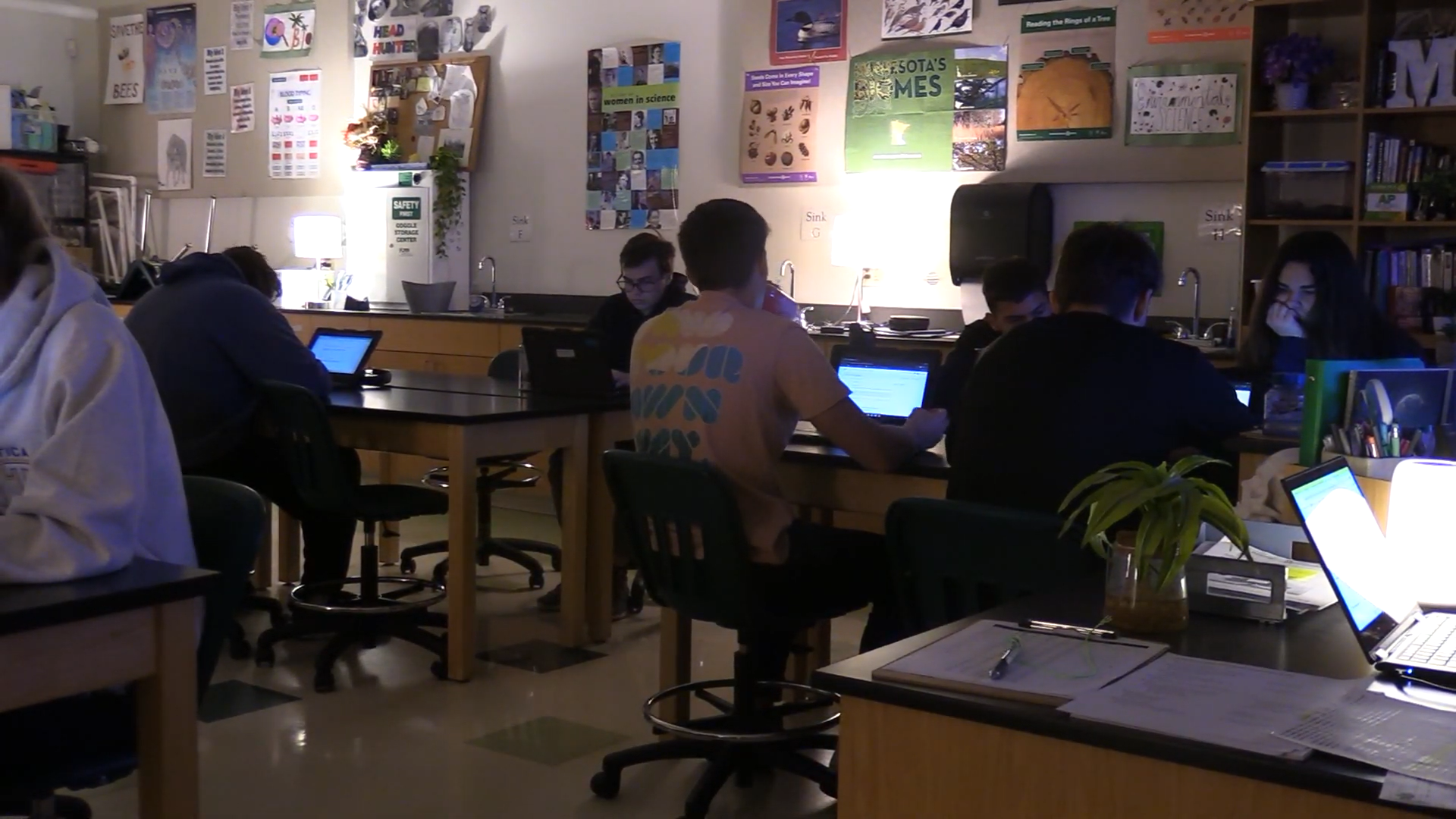

According to the American Experiment, during the 2023-2024 high school term, 24.5% of students in Minnesota were chronically absent; having missed 10% or more of the school year.
Absenteeism, a formal term for chronic absence, is a large concern in the education system, and has been for many years. There are many correlations to absenteeism and detriments to school occupation, including tardy graduation, missing fundamental information (especially when students are absent in elementary school), poor academic performance, shortening of academic integrity, etc. When it comes to Spectrum Schools, the concern still remains. Especially as a college-preparatory institution, Spectrum strives to prepare students for higher education and refined career paths, which are accompanied by necessity for disciplined attendance behavior.
With these considerations, we consulted four individuals; one an instructor, and three students; with prospects to ask them about the cohesion of attendance and educational prospects. We spoke to Autumn Mollet, a teacher of the sciences, two juniors; Simon Ruzek, and Tucker Marjama; and a sophomore, Quinn Grove. With these consultations, there was some light shed onto the subject of attendance and how it can be related to individuals’ success.
The Benefits of Consistent Attendance for Academics
Attendance, as aforementioned, can be traced back to causing major shifts in the effectiveness of a student’s academic career when it is irregular. Consistent attendance can be beneficial as far as ensuring that students are not depraved of material in class.
Autumn Mollet said, “I think then you’re never going to miss out on some important piece of information or important thing that we do in class that helps you connect the information in your brain. There’s always going to be a connection that occurs—maybe it’s the ‘aha’ moment during a documentary explanation, or in the lab as you’re working on something—or even just having a fellow student explain something to you in a different way than the teacher did. You miss out on those opportunities to make those connections if you’re not in class.”

The presence a student has in class is what allows them to be fully absorbed into what they are learning. When this presence is removed, it makes it so that the student does not have additional opportunities to connect to what they are being taught; through involvement, inquisition, speculation, tactile familiarization, or even socialization. This makes the learning process less in-depth, and when combined with inconsistencies in attendance, may lead to holes in a student’s education.
Simon Ruzek said, “It shows how reliable you can be to the teacher because it can show that […] you still have the willpower to be there and show up. […] I need something to help me be successful in the future, and it’s not just about now—me being annoyed to go to school—but it’s also about how I need that when I go to college, […] getting a job, all of that in the future.”
When students embody concordant attendance practices, it allows for development of social affinities. Students who frequently show up to school will connect more to their teachers and their administrators, which can allow for the development of a helpful professional connectivity, which can be beneficial for applying to colleges, jobs, internships, etc. Professional connectivity can be overlooked when there is a lack of involvement exhibited by a student. By missing school, there are less opportunities for students to become refined in professional socialization, which can lead to issues later in life, such as lacking professional recommendations, and stagnation in career and aspirations.
The Correlations between Attendance and Academic Disposition
When it comes to academic output, students are observed to do better in class when they are frequently coming to school. When a student is consistently at school, they are more obligated to uphold their responsibilities proactively.

“You’re always going to do better when you’re there for the information instead of trying to learn it on your own at home. Even just watching a lecture that might have been recorded, you still might miss out on some of the questions or things that other students had. […] the more you can be here for those things, the better you’re going to do in class,” Mollet said.
Negligible attendance not only removes the presence of students from school, but it also removes the presence that teachers have in a student’s education. This, similarly to a lack of presence a student has itself, can lead to faults in a student’s education, as they are not going to properly supplement information and curriculum when they are teaching themselves.
Subsequently, a student’s grades will also diminish in respect to any defects in a student’s education.
“Your grades would naturally just reflect that you haven’t been here. […] if you haven’t been here, then your grades would naturally drop because you haven’t been learning at all,” Tucker Marjama said.
Occurrences of grades dropping can generate issues—the obvious one being poor marks. However, when it comes to the reasoning for grades dropping, there can be some ethical considerations that add to the substantialization of such circumstances. Normally, when considering failing grades, the understanding of such marks is that it occurs as a result of a student’s deficiency. However, when poor grades correlate to attendance, such logic is falsified. This generates a dilemma, as, now, the student’s grades are inaccurately representing a student’s genuine academic proficiency or potential. This can result in administration and instructors not being able to properly understand a student’s capabilities and how much they are actually able to input into their classes, which, if prolonged, can result in students with academic potential to be led to detriment due to this representation of their person.
How Students’ Attendance Affects the Classroom
The frequency in which students show up to their classes can affect the flow of them. Since students are the recipients of the services provided by professors, if there are no students, nobody is available to receive said services.
Mollet said, “I feel like it’s hard to catch someone up, especially if they’re gone for most of a week. Now, with having class every single day, you’ve missed like five days worth of stuff. So, to go back and try to remember what all they need to know, what the specifics are, all the assignments they missed, […] trying to catch them up and having the time to do that and having them want to do that is really hard when students miss a lot of school.”
It can be a hassle to catch up with students who are gone, especially frequently. Because of this, it may disrupt an instructor’s plans for their classroom, and generate issues in the long run regarding curriculum coverage if there are students who are not on the same page.
How Students may Productively Utilize their Excused Absences
When it comes to absences, there is a threshold before students are restricted in accordance to the amount of days they are absent. With this, there is a consideration regarding productively and effectively using these capped absences so that students are not excessively absent and yet still fulfilled as far as their needs that can be met by missing school.
“Only utilize it when it is absolutely necessary. Obviously, if you’re sick, don’t come to school. You’re going to make the rest of us sick,” Marjama said.
As stated, absences are ideally used for necessary reasons. There are plenty of circumstances where absences are unavoidable or necessary, which is important when considering when you should be absent.
Mollet said: “Making sure you really need that day off. Minimizing the family vacations and stuff that aren’t over a break. Are you sick? Stay home. Do you need that mental day? Maybe stay home for that. But also realize that being in class is important and there are things that you need to be at school for and that help your learning.”
Absences are helpful for when students are in circumstances of difficulty; such as illness, mental unwellness, or other instances of preoccupation. When students are using these absences for trivial reasons, it takes the value out of their allotted absences.
“It’s kind of like how it is as a teacher. I only get 10 days of time off during the school year before it starts affecting my paycheck. So, those are things you have to think about when you get out into the real world, and I feel like that helps students realize those are some of those expectations as you’re getting jobs and and going out—that attendance is important and you need to be there,” Mollet said.

Considerations of time management are also prevalent when it comes to attendance. In the workforce, there is also allotted amounts of time in which someone may be away from work (in impromptu situations). By considering attendance criteria, students can develop time management skills as well as a sense of their career, as absence limits can help with understanding expectations commonly brought upon by professionals.
Grove said: “If you’re absent, something important to do is at least look at the material you’re missing and have a plan for how to make it up. Even if you’re too sick the day of, or you’re too busy the day of, to get it done. I feel like it’s important to look at it overall and be aware of what you need to do so you aren’t surprised the day you come back.”
The modern resources used at school allow students to do their work remotely. Due to this, it becomes accessible for students to maintain their academics even when they are absent from class. It is important that students utilize this to limit aforementioned issues that can potentially arise from their absences.
Why Come to School?
The question of why one should come to school is loaded, and cannot be answered with a unanimous response. However, those who have an understanding of why they should or want to come to school are those who are more likely to consistently come, even if they don’t give the same answer as someone else.
Mollet said: “I would hope they want to learn, you know, that they have classes that they look forward to, that they want to go to. I would hope that it would be the want to learn and better themselves is why they would want to come to school.”
Ruzek said: “I need something to help me be successful in the future. And it’s not just about now me being annoyed to go to school, but it’s also about how I need that if I go to college, getting a job, all of that in the future. […] Every now and again, it’s important to realize that there’s something bigger than you going on and you need to just move on.”