



Gym Floor Finishing Forces a Short-Term Academic Migration
The olfactory consequences of progress arrived sooner, and more pungently, than anticipated at Spectrum Middle School, where ongoing construction and the application of multiple layers of sealant to a new gymnasium floor necessitated the temporary displacement of sixth grade students and educators.
Spectrum’s newly additional facility is in the final stages of completing a long-awaited fieldhouse addition. However, the fume and smell byproducts made during the varnishing process permeated adjacent instructional spaces, prompting administrators to relocate sixth graders to the elementary building until the fumes dissipate.
Administrators emphasized the move is precautionary, temporary, and rooted in student and staff wellbeing.
“A Beautiful Structure” with Unanticipated Side Effects
According to Spectrum Middle School Principal, Greg Heinecke, the varnishing process—required to seal, stripe, and brand the gym floor in the newly annexed fieldhouse—produced stronger odors than initially forecast.
Greg Heinecke said, “We are building a beautiful structure that has wood flooring that needs to have lines and sealant on it. And so, what occurred was we finally reached that point where we were ready to get the Spectrum logo and the basketball lines, all those things ready to happen.”
While administrators anticipated some odor, Heinecke said the intensity proved disruptive after students and staff began experiencing headaches.
“After enduring that for a day and having headaches and things with certain students and staff members, it got to be quite a bit. So we needed to make a move,” Heinecke said.
Sixth Graders Navigate New Geography, Acoustics, and Routines
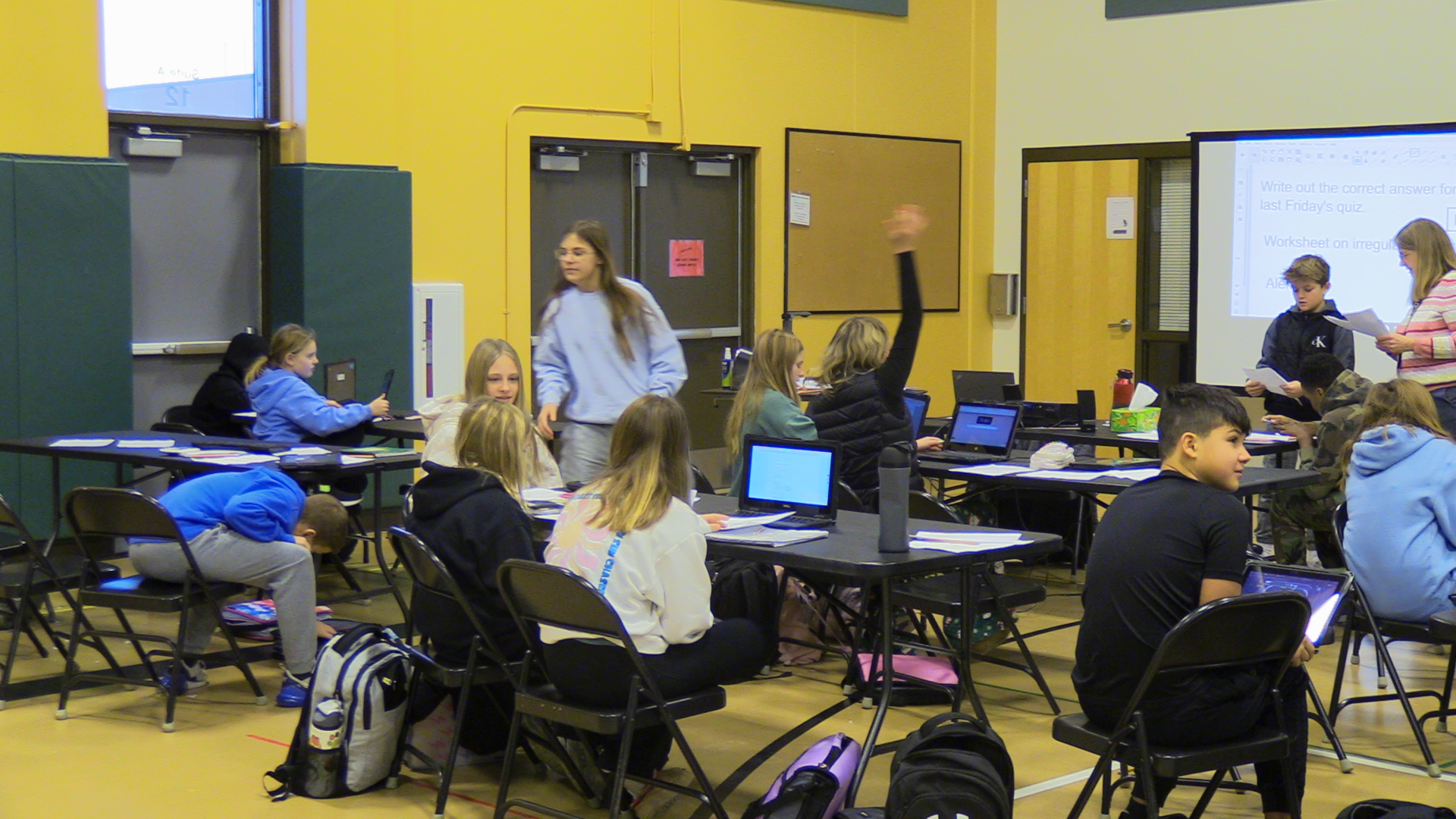
The relocation sent sixth graders—along with their instructors—to the elementary building, where a combination of vacant classrooms and improvised instructional spaces now host their daily lessons.

For students, the transition has been both novel and disorienting.
Scarlet Jingra, a sixth grader, said learning in larger, nontraditional spaces has proven challenging.
“It’s harder because it’s bigger and you can’t really hear Miss Harvill,” Scarlet Jingra said, referring to her math teacher.
The altered environment, Jingra said, has affected not only her ability to concentrate but also the classroom dynamic.
“[My classmates] just get carried away and don’t pay attention because it’s so big. They don’t pay attention to [the teacher] and stuff,” Jingra said.
Jingra added that commuting between buildings, particularly in the current winter weather, has been frustrating and occasionally disruptive to punctuality.
“I don’t like it because it’s cold out and I arrive late to my classes,” Jingra said.
Adaptation and Academic Continuity
Other students reported a more measured transition.
Olivia Aleksander, also a sixth grader, described the move as a big adjustment, despite students largely acclimating.
Olivia Aleksander said, “It’s a big adjustment, but I feel like we’re all getting used to it. All the classes are kind of close together, so it’s easy.”
While unfamiliar spaces initially posed logistical challenges, Aleksander said instructional quality has remained consistent.
“The biggest difference is probably the different classrooms, but otherwise they’re teaching the same,” Aleksander said.
Aleksander noted that makeshift setups; including desks placed in the gym; required adaptation, particularly when furniture layout limited mobility.
“The tables are a little hard to sit at,” Aleksander said.
Space Constraints Drive Creative Solutions
Administrators said the elementary building was the only feasible option for housing sixth graders due to limited space across the campus.
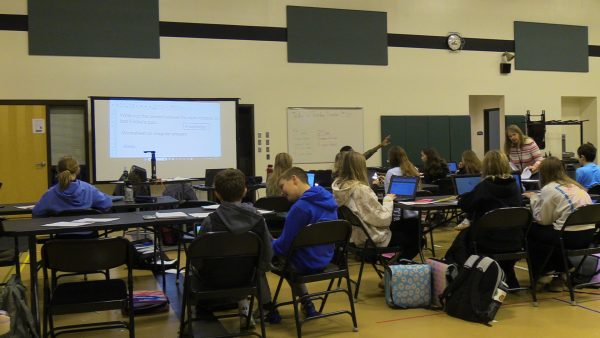
Heinecke said, “This was really it as far as space because we don’t have a lot of availability, and, honestly, this would be the only time that this could even possibly happen because fifth grade is not at student capacity; it’s at about 65-70 students so with that we have some open classrooms.”
To accommodate all sixth grade sections, staff converted the elementary gymnasium into instructional space, and, in some cases, combined classes or implemented team-teaching arrangements.
“Really, we were creative on how we use the space,” Heinecke said.
Spectrum’s executive director, Dan DeBruyn, echoed that assessment, noting the elementary building was originally designed to house more students than it currently serves.
Dan DeBruyn said, “[The elementary] building was built for six classes, […] so we had three classrooms already available.”
Fumes Prompt Swift Administrative Response
DeBruyn said administrators acted quickly once the severity of the odors became apparent.
“Well, prior to moving, any of us that were walking through there realized that it was a pretty strong smell,” DeBruyn said.
Within twenty-four hours, staff coordinated a full relocation of the sixth graders.
DeBruyn said, “It is not easy to move kids and all kinds of staff in less than twenty-four hours, but people have been very flexible.”
While some individuals may have been more sensitive to the fumes, DeBruyn said no long-term issues have been reported, and the relocation was implemented as a preventative measure.
End in Sight as Winter Break Approaches
Construction crews have completed painting the gym floor, with two remaining clear-coat layers scheduled before winter break. Administrators said the break will allow odors to dissipate before students return.
DeBruyn said, “We figured it would just be best to get everybody out, get it done before winter break, have that week and a half over break for everything to clear out and then bring people back. It should be a lot better at that point.”
Administrators anticipate sixth graders will return to their original classrooms once classes resume in January.
Willingness and Forward Momentum
Despite the disruption, both Heinecke and DeBruyn praised students, families and staff for their adaptability.
“They’ve done a really good job,” Heinecke said.
Debruyn said, “We have amazing staff, students, families, and regardless of what we’re going through or trying to adjust for, they’ve been extremely supportive, flexible, and willing to make it work.”
DeBruyn characterized the situation as inconvenient but manageable, particularly given its temporary nature.
“When you have an end in sight, you can usually get through two or three weeks of inconvenience,” DeBruyn said.
As Spectrum continues its expansion, administrators said the completed fieldhouse will ultimately benefit the entire school community—even if its finishing touches briefly displaced some of its youngest occupants.